Enormous quantities of data go unused or underused today, simply because people can't visualize the quantities and relationships in it. Using a downloadable programming environment developed by the author, Visualizing Data demonstrates methods for representing data accurately on the Web and elsewhere, complete with user interaction, animation, and more. How do the 3.1 billion A, C, G and T letters of the human genome compare to those of a chimp or a mouse? What do the paths that millions of visitors take through a web site look like? With Visualizing Data, you learn how to answer complex questions like these with thoroughly interactive displays. We're not talking about cookie-cutter charts and graphs. This book teaches you how to design entire interfaces around large, complex data sets with the help of a powerful new design and prototyping tool called "Processing." Used by many researchers and companies to convey specific data in a clear and understandable manner, the Processing beta is available free. With this tool and Visualizing Data as a guide, you'll learn basic visualization principles, how to choose the right kind of display for your purposes, and how to provide interactive features that will bring users to your site over and over. This book teaches you: The seven stages of visualizing data -- acquire, parse, filter, mine, represent, refine, and interact How all data problems begin with a question and end with a narrative construct that provides a clear answer without extraneous details Several example projects with the code to make them work Positive and negative points of each representation discussed. The focus is on customization so that each one best suits what you want toconvey about your data set The book does not provide ready-made "visualizations" that can be plugged into any data set. Instead, with chapters divided by types of data rather than types of display, you'll learn how each visualization conveys the unique properties of the data it represents -- why the data was collected, what's interesting about it, and what stories it can tell. Visualizing Data teaches you how to answer questions, not simply display information.
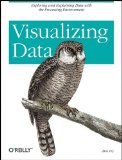
Visualizing Data: Exploring and Explaining Data with the Processing Environment
- Authors
- Ben Fry
- ISBN
- 0596514557
- Published
- 11 Jan 2008
- Purchase online
- amazon.com
Enormous quantities of data go unused or underused today, simply because people can't visualize the quantities and relationships in it. Using a downloadable programming environment developed by the author, Visualizing Data demonstrates methods for representing data accurately on the Web and elsewhere, complete with user interaction, animation, and more. How do the 3.1 billion A, C, G and T letters of the human genome compare to those of a chimp or a mouse?
- Editorial Reviews
- Customer Reviews
Editorial Reviews
You might also like...
Java books
-
Spring Roo 1.1 Cookbook
Over 60 recipes to help you speed up the development of your Java web applications using the Spring Roo development tool *Learn what goes on behind the scenes when using Spring Roo and how to migrate your existing Spring applications to use Spring R...
Java jobs
-
Build simple tools to solve complex problems at Red Gate
Red Gate Software in Cambridge, UK, United Kingdom
£35,000-55,000 GBP per year -
Java Developer - (Central London & Client Sites)
Fruitful Business Services in London (EC1V), United Kingdom
£27-45k (DOE) -
Content Developer - (Games Studio) - Cambridge
Jagex in Cambridge (CB1), United Kingdom
£Very Competitive +Excellent Benefits -
Senior C++ Developer/ Full-time Atlanta, GA for leader in Software Supply Chain Solutions
Manhattan Associates in Atlanta, United States
Competitive Salary + Bonus as well as Full Benefits (Medical, Dental, strong 401K, etc.)
Java podcasts
-
Java Posse: "Dickless"
Published 7 years ago, running time 0h0m
“Dickless”Fully formatted shownotes can always be found at http://javaposse.com *Interfaces, classes, and API design Blog: http://graphics-geek.blogspot.com/2013/03/for-api-nerds-interfaces-and-inner.html Default Methods: http://www.techempower.com/blog/2013/03/26/everythin.

Comments