Opium smoking was a widespread social custom in nineteenth-century Java, and commercial trade in opium had far-reaching economic and political implications. As in many of the Dutch territories in the Indonesian archipelago, the drug was imported from elsewhere and sold throughout the island under a government monopoly - a system of revenue "farms". These monopoly franchises were regulated by the government and operated by members of Java's Chinese elite, who were frequently also local officials appointed by the Dutch. The farms thus helped support large Chinese patronage networks that vied for control of rural markets throughout Java. James Rush explains the workings of the opium farm system during its mature years by measuring the social, economic, and political reach of these monopolies within the Dutch-dominated colonial society. His analysis of the opium farm incorporates the social history of opium smoking in Java and of the Chinese officer elite that dominated not only the opium farming but also the island's Chinese community and much of its commercial economy. He describes the relations among the various classes of Chinese and Javanese, as well as the relation of the Chinese elite to the Dutch, and he traces the political interplay that smuggling and the black market stimulated among all these elements. An important contribution to the social and political history of Southeast Asia and now brought back to life as a member of Equinox Publishing's Classic Indonesia series, this book gives a new dimension to our knowledge of nineteenth-century Javanese society and the processes of social control and economic dominance during the colonial period. JAMES R. RUSH is a historian of modern Southeast Asia whose other works include The Last Tree: Reclaiming the Environment in Tropical Asia; Java: A Travellers' Anthology; and several volumes of contemporary Asian biography in the Ramon Magsaysay Awards series. His is associate professor of history at Arizona State University.
Opium to Java: Revenue Farming and Chinese Enterprise in Colonial Indonesia, 1860-1910
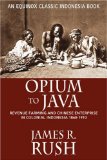
- Authors
- James R. Rush
- ISBN
- 9793780495
- Published
- 31 Jan 2007
- Purchase online
- amazon.com
Opium smoking was a widespread social custom in nineteenth-century Java, and commercial trade in opium had far-reaching economic and political implications. As in many of the Dutch territories in the Indonesian archipelago, the drug was imported from elsewhere and sold throughout the island under a government monopoly - a system of revenue "farms".
Editorial Reviews
You might also like...
Java books
-
Spring Roo 1.1 Cookbook
Over 60 recipes to help you speed up the development of your Java web applications using the Spring Roo development tool *Learn what goes on behind the scenes when using Spring Roo and how to migrate your existing Spring applications to use Spring R...
Java jobs
-
Build simple tools to solve complex problems at Red Gate
Red Gate Software in Cambridge, UK, United Kingdom
£35,000-55,000 GBP per year -
Java Developer - (Central London & Client Sites)
Fruitful Business Services in London (EC1V), United Kingdom
£27-45k (DOE) -
Content Developer - (Games Studio) - Cambridge
Jagex in Cambridge (CB1), United Kingdom
£Very Competitive +Excellent Benefits -
Senior C++ Developer/ Full-time Atlanta, GA for leader in Software Supply Chain Solutions
Manhattan Associates in Atlanta, United States
Competitive Salary + Bonus as well as Full Benefits (Medical, Dental, strong 401K, etc.)
Java podcasts
-
Java Posse: "Dickless"
Published 7 years ago, running time 0h0m
“Dickless”Fully formatted shownotes can always be found at http://javaposse.com *Interfaces, classes, and API design Blog: http://graphics-geek.blogspot.com/2013/03/for-api-nerds-interfaces-and-inner.html Default Methods: http://www.techempower.com/blog/2013/03/26/everythin.

Comments