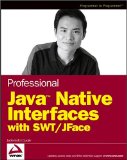
Professional Java Native Interfaces with SWT/JFace (Programmer to Programmer)

Professional Java Native Interfaces with SWT/JFace (Programmer to Programmer)
Authors
Jackwind Li Guojie
ISBN
0470094591
Published
11 Feb 2005
Purchase online
amazon.com

Professional Java Native Interfaces takes a solutions-based approach in showing how SWT/JFace works, discussing each common component, providing useful, practical ideas, tips and techniques to make the Java developers' work easier. The author provides relevant and timely examples, both stand-alone applications and smaller code snippets that readers can incorporate into their own code.

Page 2 of 2
  1. Editorial Reviews
  2. Customer Reviews

Customer Reviews

Robert Stevenson said
Unfortunately, the phrase "Java Native Interfaces" is in large letters and "with SWT/JFace" are in a much smaller font. It should have been the other way around because the complex subject of JNI is barely touched on here. I cannot comment on the SWT/JFace coverage because that was not my object, but if you are looking for a book that will tell you how to put C++ and Java code together, this one probably won't help.

John Matlock said
One thing you gotta love about the Java crowd is their naming philosophy. Now there is SWT, the Standard Widget Toolkit.

This book covers SWT as used in conjunction with Eclipse. It first compares SWT with other user interface packages, then it goes on to detail how to use the widgets to facilitate the writing of GUI's. It's a tutorial style book that completely covers Version 3.0 of SWT/JFace in a clear and informative manner.

This book is timely, clear and well written. It will quickly get the reader up to speed on these packages.

You might also like...

Comments

Contribute

Why not write for us? Or you could submit an event or a user group in your area. Alternatively just tell us what you think!

Our tools

We've got automatic conversion tools to convert C# to VB.NET, VB.NET to C#. Also you can compress javascript and compress css and generate sql connection strings.

“There are 10 types of people in the world, those who can read binary, and those who can't.”