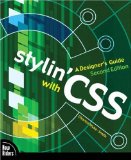
G. Shalhoub said
I have looked at a number of books to help me get started again in web page design. Stylin' with CSS is by far the best book Ive found. It is very readable, well-organized, and proceeds in a logical manner from some XHTML through the important aspects of CSS. The book covers, layouts, positioning, styles and a host of other topics. Many examples are presented in a clear manner. You can download examples from the author's website for even more information. Stylin' with CSS is a real winner! Highly recommended.
Matilda Mason said
The best introduction to XHTML and CSS I've found. Explains everything you need to know to get up to speed, with lots of always-relevant extras. Excellent layout, with helpful sidebars that saved me tons of time in not having to hyperlink away for more information.
JD said
This is an excellent book on css. It is the best book on css that I own, and I own a several. It is well written, and does a great job of explaining nuances.
The book is also physically appealing. The pages lay flat, unlike some books that you have to hold in place, and there is room on the page to take a few notes and underscore important concepts.
CSS is deceptively difficult. It starts out easy enough, but it is full of quirks and browser incompatibilities. And small quirks can turn into big pains. This author does a great job of addressing those quirks, and he offers suggestions on avoiding the css pitfalls.
T. Reed said
As someone who has a fairly solid grounding in CSS basics, but is seeking to improve his understanding of some concepts, I read this book with a slightly different view than some. I came into the book expecting the first few chapters to be of little use to me, and was not surprised, but I also felt that they would provide excellent grounding for a beginner.
Where my review begins to take a turn for the worse comes towards the end of the book. One problem I had came from the "Creating CSS-Based Menus" section of chapter 6, on creating pop-up menus without JavaScript. Early in this section, the author floats the items in a list, and shows that the enclosing
- tags "close up" since there is no non-floated content. This makes sense, but then he says that if you were "paying attention in the Floating and Clearing section of Chapter 4," you'll know you should float those items as well to make them expand to enclose the floated list items. Although I had read and understood that section, this was in no way clear to me as the best solution, and I was left wondering why. I have not yet found a better solution, but lack of explanation has left me feeling that this is more of a hack than an ideal solution.
I became further concerned that the author has too much love for floats later on when he demonstrates a single line of text right-aligned using a right float, despite the fact that there was no content for it to float to the right of. I did not understand why he did not use the more semantically-clear CSS "text-align: right;"
I also felt that there were a lot of topics left unexplained and booby-traps left for the inexperienced coder. For example, using the author's 2-column layout code works, but there is no mention of the fact that, if you for some reason wanted to omit the enclosing wrapper, the floated nav block and the content block no longer have their tops aligned. This, and other problems, could easily befuddle novices trying to adapt his techniques to their own sites, when simple explanations of such problems would have been easy.
My final problem: Appendix B is completely useless. I am assuming it has not been updated in some time, as it makes no mention at all of Internet Explorer 6, 7 or 8, Firefox 2 or 3 or any version of Safari. Since these browsers are the most commonly-used browsers now, by his own admission earlier in the book, this appendix becomes nothing more than a footnote of history.
Ephraim Schum said
I got this book along with a few more books on CSS and found that this book was by far the best and most conclusive. The step-by-step color examples as well as the actual code was by far the most helpful. The code I have tweaked to work for several client sites and have found it to be easy to understand. The author provided a complete ZIP file of CSS with excellent notes (how-to's) and even responded to an email I sent him regarding his code and using it. The drop-down menus examples have been the most beneficial. I have applied most of the content of this book to everyday web projects. Buy this book first!

Comments