Pamela Raisanen said
What a treasure! This book is now number one on my favorite gifts to give list. Whether used as a travel planner, an overview of important discoveries or just to curl up with on the couch for a few minutes of relaxation, this book is a delight.
The Geek Atlas covers 128 places to visit that are science/math/technology related. Graham-Cumming's book focuses on sites where contributions are presented in a serious manner and skips places that portray science as fluffy entertainment based. This is both a good resource for travelers, geeks, and science buffs, as well as a great read. The chapters are an average of four pages long and packed with interesting, well organized information. They contain a description of the location, a related technical subject and visiting details. Links to associated websites are also included. Best of all, the science is explained in an easy to understand manner. We'll all be waiting impatiently for a second edition. Thank you, John Graham-Cumming!
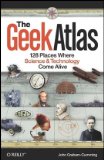
The Geek Atlas: 128 Places Where Science and Technology Come Alive
Ben Rothke said
A recent search on Amazon for travel guides returned over 30,000 results. Most of these are standard travel guides to popular tourist destinations which advise the reader to go to the typical tourist sites. The Geek Atlas: 128 Places Where Science and Technology Come Alive is a radically different travel guide. Rather than recommending the usual trite destinations, which are often glorified souvenir stores, the book takes the reader to places that make science real and exciting, and hopefully those who exit such places are more knowledgeable than when they went in.
Irrespective of its travel content, The Geek Atlas is a unique and fascinating read for the information and overview of its wide range of topics. If there is a fault in the book, it is with its title. When people see Geek Atlas, they might think that this is a book that takes the reader to boring and obscure places, which is the exact opposite of its intent.
Author John Graham-Cumming writes that you won't find tedious, third-rate museums, or a tacky plaque stuck to a wall stating that "Professor X slept here". Every place he recommends is meant to have real scientific, mathematical, or technological interest.
Each of the books 128 chapters is separated into 3 parts: a general introduction to the place with an emphasis on its scientific, mathematical or technological significance; a related technical subject covered in greater detail, and practical visiting information. So while you may not be able to make it to the Escher Museum (chapter 29) in The Hague, Netherlands; the information on how M.C. Escher used impossible shapes in which the chapter describes is a fascinating read on its own.
Graham-Cumming notes that a disappointing trend with science museums today is a tendency to emphasize the wow factor without really explaining the underlying science. He notes the following 3 attributes of such museums: a short name ending with an exclamation mark, a logo featuring pastel colors or a cuddle cartoon mascot, or an IMAX theater.
Why does the book specifically have 128 places listed? See chapter 58, for the National Museum of Computing in Bletchley, UK. Graham-Cumming notes that your average travel guide would have listed perhaps 100 or 125 places. 128 is a round binary number (10000000). Of course, those who are binary obsessed might wonder why this book is not titled 10000000 Places Where Science and Technology Come Alive.
The 128 places listed are for the most part divided equally between sites in Europe and the USA, with a few in the Far East and Russia. A complete listing of the sites is mapped on the books web site. Africa for some reason seems to be left out and perhaps a follow-up volume will fill that void. Of course, one could argue that Africa has had a minimal contribution to the world of science, mathematics and technology. Nigeria for example is famous for its 419 advance-fee fraud, but not its overabundance of contributors to physics.
For the US locations, there are locations for 25 states, with California being the biggest with 7 suggested places to visit. With that, it is surprising that the book lists the HP Garage, given that it is not open to the public and only serves as a shack to be photographed. Other places such as the US Navy Submarine Force Museum and MIT Museum are indeed more visit worthy.
The tours of some of the sites, like the HP Garage will take less than an hour or so (chapter 42 -- Bunhill Fields Cemetery, London, UK), while others one can spend a half or full-day at the site.
While The Geek Atlas is touted as a travel guide, it is much more than that. Its 128 chapters are a wide-ranging overview of science and mathematics. Topics run the gamut from physics and pharmacology to transistors and optics. In fact, the book would make a superb syllabus for an introduction to science course. The plethora of subject covered, combined with its easy to read and absorbing style makes it a fantastic book for both those that are scientifically challenged, yet curious, and those that have a keen interest in the sciences.
The Geek Atlas is a fascinating and enjoyable read; in fact, it I found it hard to put down. Lets hope the author is working on a sequel with the next 256 additional places where science and technology come alive.
Draco Mal Trapnet said
Good book, I like how each location is reviewed and their scientific or geeky break down of the significant role the location has in science. I have shown this book around to some friends who were interested in it. I'll definitely check into this book before I take any cross country trips to makes sure I dont miss something interesting on the way.
Matthew G. Woodard said
I am a new father, and I bought this book with one thing in mind: to find new science-related places to take my son as he grows up. I imagined classic family vacations that might have been planned by Clark Griswold, with a little more emphasis on learning than is typical of a National Lampoon movie. I am happy to say I'm not disappointed. In fact, I got much more out of this book than I'd planned.
Within minutes of opening the book, I'd found three must-see locations that I could visit just on a trip back home to my family. The atlas includes the details you need to plan a satisfying trip. Its clear what locations are child friendly, which have food available, etc. But this only scratches the surface of the material. The inclusion of related information, anecdotes, and a real discussion of the scientific background of each site turns a travel guide into so much more.
If you've ever enjoyed watching a show on the discovery channel that delves into the curious stories and theories behind a famous person or place, you'll love the book. The author writes with an entertaining style that I enjoy, and I think will capture the attention of anyone with an interest in the sciences. As my son grows up, I plan to stimulate his interests by sharing the book with him. I have an older niece who is beginning to take a interest in such things, and I have similar plans for her. I recommend the same to any parent interested in sparking their kids' imaginations.
Finally, I wanted to mention some personal connections I have with the book. I was a physicist in college, and I was fortunate to participate in a number of programs during my time at university that took me to a few of the places mentioned in the book. I got a nostalgic thrill when I discovered that places from my past were in the book, and I appreciate my own experiences more after reading about them. The history behind the National Radio Astronomy Observatory in Green Bank, West Virginia is a great example. I wish that I had an Atlas back then. I would have gotten even more out of my travels.
I highly recommend this wonderful book.
Marie Curie said
I absolutely love this book! Not only does it provide useful information (e.g. what you will see at the location, whether a tour is provided in English, and websites containing more information on how and when to visit), but for each location it provides a section explaining some aspect of science and technology (e.g. how a diesel engine works, or an explanation of iron allotropes). I found it very enjoyable to read, which can't be said for most travel books (at least not the ones I've read). I highly recommend this book to anyone with a passion for science and technology!

Comments