Barbara Hansen said
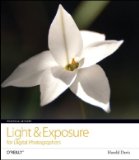
Practical Artistry: Light & Exposure for Digital Photographers
by Harold Davis Published by O'Reilly 2008
A Review by Barbara Hansen, Golden Gate Computer Society
Digital photography is sometimes described as painting with light. This beautifully illustrated book explains how to use a digital camera to do just that.
The first few chapters go in a detail explanation of the importance of correct exposure. The relationship of aperture, shutter speed, ISO (light sensitivity) and white balance are all discussed in great detail to explain exposure.
Harold says that: " The most fun in digital photography begins after you take the photo," but that is no excuse for taking badly exposed pictures.
Each chapter is illustrated with photographs taken by the author with all the meta data recorded and personal comments on what he was trying to do and how. It is fun just to flip thru this book viewing the beautiful shots and reading just how they were done. Since the author lives in Berkeley, most of the photographs were taken in the Bay Area and particularly in Marin, which is instructive for local photographers.
The last chapter of the book is called the Digital Darkroom and it really gets down to the nitty gritty of editing photographs in Raw. It has one of the best explanations of combining different layers of a photo using masks and blending modes. And his definition of the blending
modes such as: Color, Luminosity, Multiply, Screen and Soft light make more sense to me than anything else I have read. His discussion of Cross Processing and transforming color photos to Black and White have me eager to try out some of his techniques.
This is a beautiful book with lots of technical goodies for the avid photographer and I would recommend it for your library. Harold Davis also writes a popular Photoblog 2.0 at [..] as well as other books on photography.
5 Stars
Mohanpreet Singh said
I am new to photogrpahy and ended up buying so many books. But this one is really amazing, the way author has explained the exposure and its three components is very helpful.No other photographer is so comfortable/open to discuss in detail how they took those pictures. I also read his blog and the way author describes how to take pictures with creative exposure and enhance those pictures in Photoshop is also examplary... no one else tells the whole story.Though I am a starter, I am sure even the pros would find those things very helpful.
His knowledge of nature and science is also wonderful and he relates it to photography really well.
I wish i had bought this book earlier, and also that those camera companies contact him to write their extended user manuals.
Sharon Gordon said
This is a beautifully printed book, but I found it way too technical for me. Much too much information on the subject that I didn't relate to. Plus, I was not attracted to the photograph examples at all. I don't particularly enjoy abstract art and the very arty look that leaves out the realism that I do enjoy. So, I did not find this book very helpful and would definitely not have purchased it if I had held it in my hands in the store and looked through it.
Midwest Book Review said
Modern digital cameras offer lots of sophistication but if you want to produce memorable results, you can't rely on automated exposures alone. Photographer Harold Davis here provides exposure principles to take great photos, supplementing his tips with eye-catching examples created from his own techniques. The photos offer lessons on applied techniques and this is a perfect choice for any library catering to pro or neo-pro digital photographers.
Diane C. Donovan
California Bookwatch
Josh Fisher said
I am an amateur photographer, I care about it, and I enjoy reading about it. I find the discussion of the mechanics of getting a good shot in most photo books, and especially those with "digital photography" in their titles, really frustrating. I find they either explain how typical generic controls work (I can read the manual, thanks, and get that information about the actual camera that's in my hands), or they give a dry discussion of the relationships among the various factors and choices, without relating it meaningfully to the picture that comes out. Sometimes they are mostly a gentle introduction to Photoshop.
The least satisfying books, and there are lots of them, are the ones whose authors approach digital photography as simply a logical continuation of film photography. This happens in every field in which there is a "paradigm shift" and, believe me, digital photography is a paradigm shift. It's almost as if they do a "search and replace" on their old knowledge. Really, things are different here and, except for a couple of cultural artifacts (like the fact that we get a handful of F-Stops instead of the continuous aperture function digital could offer), one needs to start fresh.
The reason I'm griping about other books is to contrast them with this terrific and refreshing book. Although the book covers lots of other topics, the main theme is exposure (and thus light). Davis clearly correlates what you do with the dials with what comes out in your shots, and he illustrates the correlation with his own beautiful pictures. He expresses technical details and concepts clearly, and writes intelligently without ever talking down to the reader. And he does so from the perspective of true digital photography.
We all know that there are plenty of aspects of artistry that have little to do with the word "practical". But with photography, the practical side of artistry is 90% the use of light. Unless you are very lucky, you will not get that special shot unless you know how to turn those dials. Davis does a marvelous job of teaching just that.
I had the good fortune to read this book before it was published and offer comments to the author on some of the technical aspects. I recently saw the reviews on Amazon, and was delighted--but not surprised--that they were so positive. This is a book I'm really glad to own.

Comments